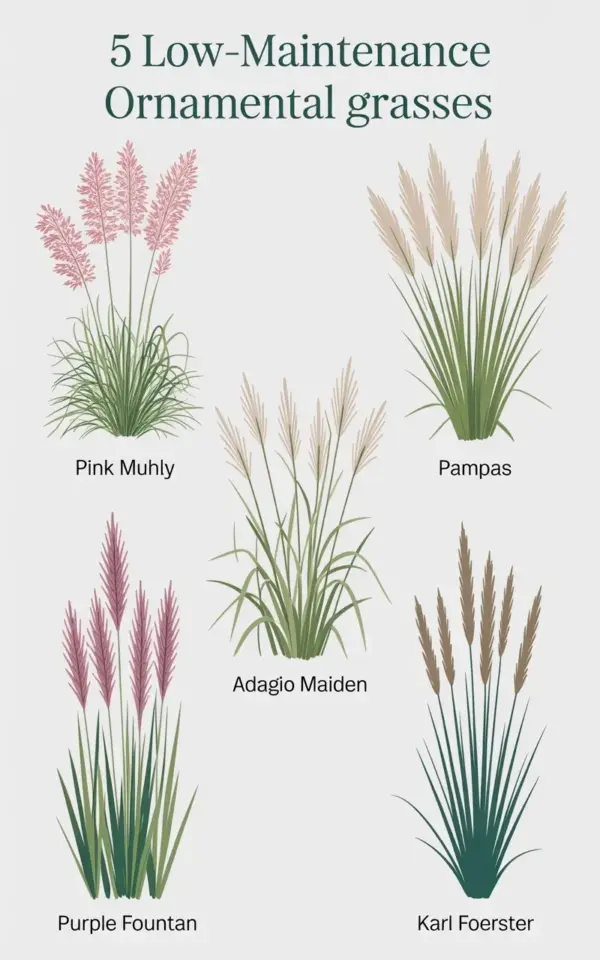
Last spring, I stood in a garden center holding a pot labeled “Giant Reed” and thought, how bad can it be? Eight months later, that thing had taken over a third of my backyard. I learned the hard way: picking an ornamental grass without a visual guide is like choosing a partner from a blurry profile photo. You get surprises, and not the good kind.
The fix is simple, though. You just need to know which grasses stay put, look good for more than a week, and don’t demand constant babysitting. The five below are the ones I trust now, the same ones shown in that lovely botanical illustration grid with the teal header. Save that image, honestly, it’s a better cheat sheet than most nursery tags.
Why buying grass from a tiny pot is a gamble
Nurseries sell most perennials in gallon containers that hide the plant’s true personality. You see a neat little clump of green fuzz and assume it will stay that size. Then it goes into your garden and turns into a five-foot beast that flops over the sidewalk.
The biggest mistake I see, and made myself, is ignoring mature dimensions. Or worse, ignoring how the grass spreads. Some ornamental grasses send runners underground and pop up three feet away from where you planted them. That’s not low-maintenance; that’s a part-time job.
The second mistake is choosing based on a photo of the seed head without checking if your climate even supports it. A grass that looks ethereal in a catalog might sulk in your humid summers. The good news? Every grass on this list is forgiving enough for a beginner, but each has its own quirk.
Pink Muhly grass, the cotton candy cloud
Pink muhly (Muhlenbergia capillaris) is the first one that made me understand why people obsess over ornamental grasses. In early fall, those airy pink plumes appear like someone sprayed cotton candy across the plant. The color is so intense that it almost doesn’t look real.
What nobody tells you is how dry and tough it is. This grass thrives in poor soil, handles drought like a champ, and never needs fertilizer. I planted mine in a rocky corner where nothing else would grow, and it turned into the neighborhood showstopper.
One thing to note: pink muhly looks like a boring green mound for most of the year. If you plant it expecting constant color, you’ll be underwhelmed from June through August. But that one spectacular month? Worth every plain day.
Pampas grass, the drama queen that needs space
Pampas grass gets a bad rap, and honestly, some of it is earned. The plant can reach eight feet tall and just as wide. Put it in a small border and you’ll have a monster blocking your windows. This is not the grass for a tidy suburban lot.
But for a large open area, pampas is about as low-maintenance as it gets. The plumes are those wispy, light beige feather dusters that show up in late summer and stay through winter. No deadheading, no staking, no pest problems. You just cut it to the ground once a year, and that’s it.
Here’s the catch I wish someone had told me: wear heavy gloves and long sleeves when you prune it. The leaf edges are razor sharp. I learned that the hard way with a forearm full of tiny cuts that looked like I’d arm-wrestled a feral cat.
Adagio maiden grass, the polite neighbor
If you want the graceful, fountain-like shape of a large maiden grass but your garden is small, adagio is your answer. It stays around three to four feet tall, which is manageable for a front yard bed or a narrow strip along a path.
The plumes in the illustration are light green, but they turn a soft beige as they dry. What I love is that adagio doesn’t reseed everywhere. Many maiden grasses drop seeds and create volunteer seedlings all over your lawn. This one behaves itself.
It’s also one of the earliest grasses to green up in spring. While other perennials are still waking up, adagio is already pushing fresh growth. For a low-maintenance option, that’s a big deal, because it means less time staring at bare dirt from March to May.
Purple fountain grass, the annual that works overtime
Here’s the honest truth about purple fountain grass: in most climates, it’s an annual, not a perennial. The deep purple-pink plumes and burgundy foliage are stunning, but it won’t survive a cold winter. If you live in zone 8 or warmer, you can plant it as a perennial. The rest of us treat it as a gorgeous season-long color burst.
Does that make it low-maintenance? Kind of. You buy it, plant it, water it occasionally, and it looks fantastic from midsummer until frost. No dividing, no pruning, no fuss. But you’ll have to re-buy it every year, which feels wasteful unless you see it as the equivalent of a giant, beautiful annual flower.
I actually grow three of them in pots by my front steps. In the illustration, the plumes look almost black-purple, and that’s accurate in person. They’re the closest thing to fireworks in the plant world, and they pair beautifully with pale yellow nearby, trust me on that.
Karl Foerster, the steady classic
If you want a grass that does exactly what you expect, no surprises, no drama, Karl Foerster is the one. It sends up straight, vertical stems with dark green plumes that turn golden in fall. The whole plant stands at attention like a disciplined row of soldiers.
This is the most widely used ornamental grass in landscape design for a reason. It tolerates wet soil, dry soil, clay, sand, and everything in between. I’ve seen it thrive next to a downspout and also in a forgotten strip where the sprinkler never reached. Karl Foerster doesn’t care.
It also provides winter interest. The dry stems stay upright through snow and ice, which gives your garden structure when everything else is mush. Cut it back in early spring before new growth starts, and you’re done. That’s the entire maintenance schedule. No staking, no dividing for years, no deadheading.
How to choose your own low-maintenance grass
All right, so you’ve seen the five in that botanical grid. But which one belongs in your yard? Here’s a quick way to filter them:
– Tiny garden or tight spot? Go with Adagio Maiden or Karl Foerster. Both stay neat and narrow.
– Long season of color? Purple Fountain grass, but remember it’s an annual in cooler zones.
– Dry, rocky, or neglected soil? Pink Muhly will outwork everything in sight.
– Open field or huge border? Pampas grass, if you promise to keep it away from walkways.
– Need winter structure? Karl Foerster and Pampas both hold their shape beautifully.
Don’t overthink the perfect placement. These grasses are forgiving, but they will not tolerate being smothered by mulch or planted in a bog. Give them decent drainage and at least six hours of sun, and they’ll basically run themselves.
For the clumping types like pink muhly and Karl Foerster, you can divide them every few years to get free plants. Wait until early spring, dig up the crown, and split it with a sharp shovel. That’s the only optional task on this list, and it’s entirely up to you.
When you’re at the nursery, do what I didn’t do that first time. Look at the tag, look at the illustration, and then look at a photo of the mature plant online. The grid on that Pinterest pin is a perfect starting point, but seeing the grass in person beats any picture. If you can find a local botanic garden, go see them growing in real ground first. That’s how you avoid the mistake I made, and how you end up with a low-maintenance garden you actually enjoy.
So which one’s your favorite? I’ve got a soft spot for pink muhly, but Karl Foerster is the workhorse I’d never skip. If you’re ready to swap out a fussy plant for one of these, start small, one grass, one patch of sun, and see how good it feels to have a plant that just stays out of your way. You might even gain enough free time to sit in the yard and admire it.
Leave a Comment