I’m going to be honest with you about ornamental grasses, and it’s not the stuff you usually read in glossy garden magazines. I learned this lesson the hard way in my own backyard, with a shovel in my hand and a very specific feeling of regret. When I first started planting, I was obsessed with the idea of a low maintenance garden, but I completely ignored the little tags that said “mature spread.” Big mistake. Huge. If you are planting low-maintenance ornamental grasses, don’t make the mistake of ignoring how wide they get. Let me tell you what actually happened.
The Ugly Truth About “Low-Maintenance” Labels
We all want that breezy, prairie-style look without breaking our backs. The marketing works. You see a photo of a massive, fluffy Pampas grass and think, “I need that in my life.” But the reality of a low maintenance garden is that it requires a ton of upfront *thinking* to save you from the *doing* later.
I remember standing in my nursery cart, looking at three adorable one-gallon pots. They looked so small and fragile. I planted them about a foot and a half apart because I wanted an “instant” lush border. Honestly, I was just impatient. The soil was decent, the sun was perfect, and within ten weeks, those “small” plants became behemoths. The Pink Muhly grass specifically turned into a cotton-candy monster that ate my pathway. I couldn’t walk to my compost bin without getting sliced by the blades. It was a genuine accessibility issue for my own yard. (A weird thing to complain about, I know, but it was annoying.)
Mature Spread: The Number You Can’t Ignore
Look, the tag says “spreads 3 feet.” That sounds like a lot when you’re looking at a nine-inch rootball. But you need to multiply that radius in your head and imagine it occupying that space in *all* directions. That means you need a three-foot hole, not a three-inch slot.
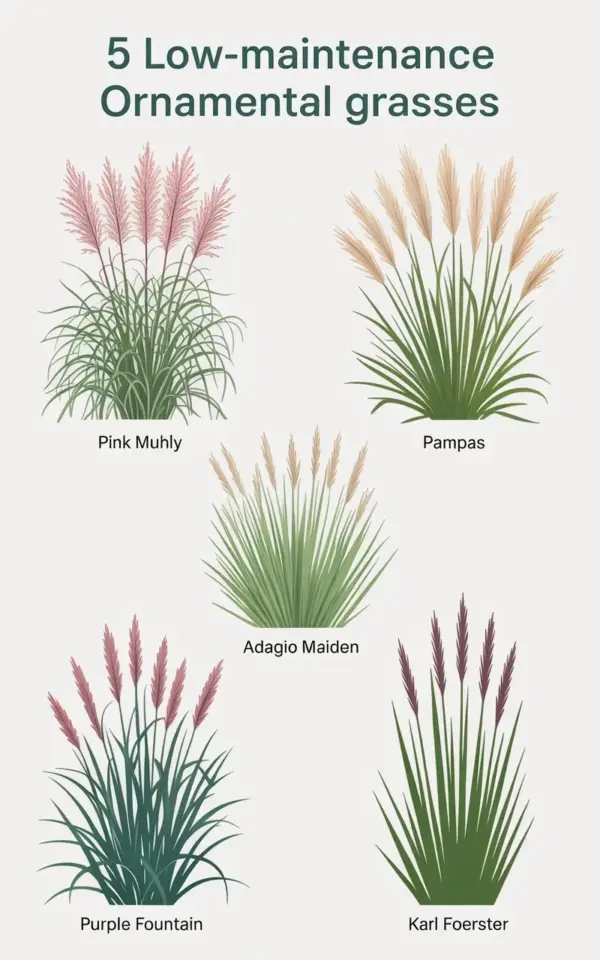
Here is a bulleted list of the five grasses from the guide, along with the spacing they actually need to thrive:
– **Pink Muhly:** Needs at least 3 feet of clear air around it. The pink plumes need room to catch the morning light, otherwise they just look like a matted mess.
– **Pampas:** This is the drama queen. Give it a massive 6 to 8 feet. It will take it all. It will also cut you if you get too close, so plant it away from walkways.
– **Adagio Maiden:** A polite grass, but still needs 3 feet. It looks better when it can gently flop without choking its neighbor.
– **Purple Fountain:** Treated as an annual in colder zones, but if it survives, give it 2 to 3 feet. It wants to be a fountain, not a puddle.
– **Karl Foerster:** Give it 2 to 3 feet. This one is a workhorse, but it gets floppy if crowded.
The list is simple. My execution was not. I packed them in tighter than sardines because I wanted privacy, but instead, I created a fungal paradise because there was no air circulation.
Why Crowded Grasses Ruin Your Garden Design
When you ignore the mature spread, you aren’t just creating a physical tangle. You are ruining the entire visual rhythm of your garden design. Ornamental grasses have unique shapes that are meant to be seen individually. The vertical, sharp “spire” of Karl Foerster looks incredible when contrasted against the mounding, fluffy softness of Pink Muhly.
When they are shoved together, those distinct personalities collide. It becomes a blob. Instead of seeing the feathery plumes of the Adagio Maiden dancing independently, you see a wall of green mush. The whole point of using grasses is to add texture and movement. You lose that dynamic entirely when they are touching shoulders. Give them space so they can actually sway in the wind. That sounds like woo-woo gardening speak, but it’s real. The wind needs to get between them.
A Better Way to Space Your Grasses
Ok so, what do you actually do if you have a small yard or you want a full look quickly? I learned that planting in drifts of *odd numbers* is way better than a straight line. Instead of planting three different types of grasses in a row, try planting three of the same variety in a loose triangle.
Here’s a tip that took me forever to learn: measure the mature spread, and then add one extra foot. If the tag says the Purple Fountain grass will get 2 feet wide, plant it 3 feet from its neighbor. That extra space allows for the “lean.” You have to account for the fact that these guys flop over the path, they lean toward the sun, and they grow outward faster than you think. Honest to God, I thought my soil was magical for the first month. No, they were just stretching out to find their personal space.
– Measure the width, then add 12 inches.
– Water thoroughly after planting to settle them in, but then step *back*. Do not crowd them with more plants.
– Use that empty space for spring bulbs like daffodils. They pop up and die back long before the grass really fills in. It gives you color without competing.
Watering, Feeding, and the “Ignore” Approach
This is where the “low-maintenance” part actually kicks in. Once established, these grasses are tough. The root systems go deep, and they are mostly drought-tolerant. But while they are young, you have to be a helicopter parent. Water them regularly for the first season, deeply. After that, honestly, I just leave them alone.
Here’s the thing: Ornamental grasses do *not* need heavy fertilizer. Fertilizing them makes them grow too fast, get floppy, and fall over. They are like those kids in school who ate a bunch of sugar at recess; they just crash. If you have decent soil, don’t feed them. They will stand up straight on their own if you don’t baby them. This is the “tough love” approach to a low maintenance garden. It works. I stopped feeding mine three years ago, and the stems are actually stronger.
Cutting Back: The Only Chore You Can’t Skip
Some people say you should cut them back in the fall. I say wait until late winter or early spring. The old blades and plumes actually help insulate the crown of the plant through the cold months.
But here is the mistake I made that *really* drove me crazy: I waited too long in the spring. The new green growth was already six inches tall, and I was wrestling with the dead, tan growth to cut it away. It was a mess. Now, I cheat. I use a bungee cord or a long piece of rope to tie the whole clump upright into a tall, tight column. Then I take a hedge trimmer and just buzz it clean off close to the ground. It takes about three minutes per plant, and I don’t have to wrestle with a giant haystack. Look, it looks super silly doing it, but the results are perfect. If you have a big Pampas grass, wear a leather jacket and gloves, though. That stuff is like a serrated knife, I’m serious.
Don’t Forget the Visuals (And the Graphic)
I recently saw a botanical illustration guide that put all of this into perspective. It showed the five varieties on a simple white background with teal text reading “5 low-maintenance ornamental grasses”. It was so clean. It didn’t try to squeeze them together in a tiny pot. Each labeled grass, from the pink-tinged feathery plume of the Pink Muhly to the deep purple-pink of the Purple Fountain, had room to breathe on the page.
That graphic is a great checklist. Save it. Look at how the Pampas grass has light beige wispy plumes and green stems, completely different from the dark green plumes of the Karl Foerster. Use that contrast in your yard. Mix textures, mix colors, but do *not* mix them in the same hole. The best landscaping ideas usually follow the “less is more” rule. Give each specimen a spotlight.
Final Thoughts on Giving Them Room
There is a specific joy in watching a single specimen grass grow to its full glory. It’s like watching a dog finally get to run off-leash in a huge park. You don’t need to micromanage it if you set it up right. If you provide good drainage, plenty of sun, and most importantly, generous space, these grasses will basically take care of themselves through heat waves and heavy rain. They are the ultimate set-it-and-forget-it plant, but only if you let them expand their shoulders.
So, before you dig that hole and plop in that tiny little starter plant, just do the math. Lay your measuring tape out on the ground. Live in that future size visually. If you plant them correctly, you’ll have a beautiful, swaying landscape that requires almost nothing from you but patience. And honestly? That’s the best kind of project. Now, go plan that border and save yourself the backache. Happy planting, and give them some space! 🌾
#ornamental grasses #low maintenance garden #garden design #perennial grasses #landscaping ideas
Leave a Comment