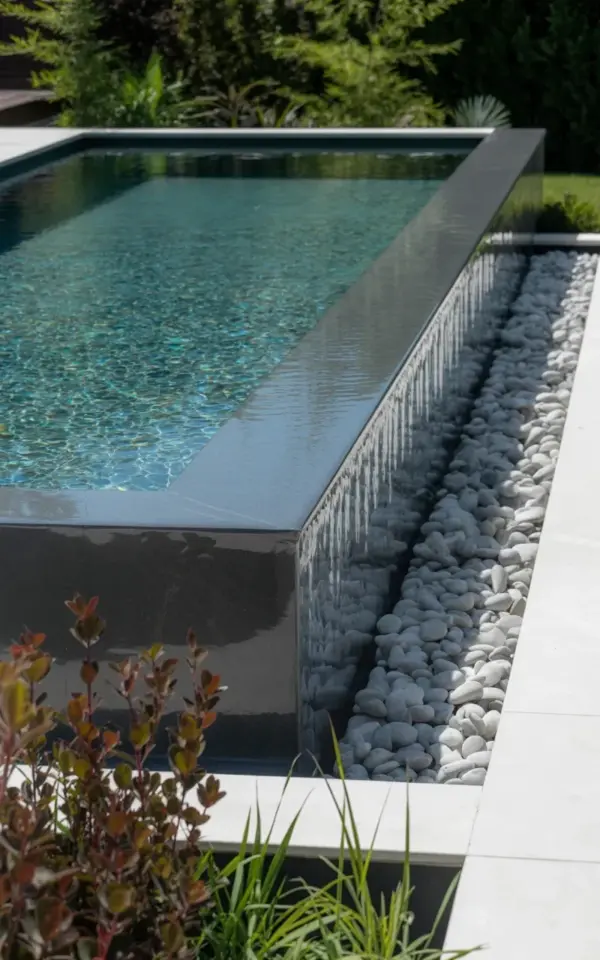
There’s something about a modern minimalist pool that just hits different. Especially when it pairs a clean rectangular shape with a black concrete water feature. The photo above is exactly what I mean. That dark, sleek edge running the pool’s length, spilling water in a thin, even sheet. And then on the other side, those smooth gray river rocks lining the border. It’s not trying to be a tropical resort or a Roman bath. It’s just quiet, intentional, and honestly a little dramatic. The red-leafed plants and grasses peeking in at the bottom edge? They break up the seriousness. That turquoise water rippling in the middle of all that restraint. So yeah. I wanted to write this as a how-to guide because replicating this look takes specific choices. Not generic ones. Here’s how you actually pull it off, step by step.
Getting the Rectangle Right: Layout and Proportions
Before you fall in love with the black concrete waterfall, you need a pool shape that can carry that weight. A rectangular pool is the obvious match here. But not just any rectangle. The proportions matter a lot. Go too narrow and it looks like a lap lane. Too wide and you lose that sleek, linear tension. Shoot for a length to width ratio around 3:1 or 4:1. It’s the sweet spot for a contemporary backyard. That long side becomes the stage for your water feature.
I have a strong opinion here. Avoid curves. Even gentle ones. The whole point of this minimalist approach is that hard, clean line running from one end to the other. A curve breaks that visual rhythm. Plus, curving the side makes the black concrete waterfall installation way more complicated and expensive. Keep it straight.
Also, consider the pool’s depth relative to the surrounding hardscape. The pool in the photo sits flush or nearly flush with the deck. That’s not an accident. A raised pool edge would make the waterfall feel separate, like an attachment. A flush edge integrates everything. It makes the water look like it’s just a thin skin on the ground. That’s the magic trick.
- Measure your available space and mark out a rectangle at least 12 feet wide.
- Stay honest with your contractor about the 3:1 ratio. Don’t let them talk you into a kidney shape.
- Plan for a flush or slightly negative edge deck (a vanishing edge but on the side, not the far end).
- Real talk: Deck drainage is critical here. Water splashes. You need a slight slope away from the pool edge so you don’t get a permanent puddle zone where the grass meets the concrete.
- Check local setback rules. You might need more space than you think.
Building the Black Concrete Water Feature (The Actual Star)
Ok so, the black concrete water feature. Look, this isn’t a standard preformed spillway you buy at a big box store. This is a custom concrete pour, usually done with an integrally colored black concrete mix. Or you can do a black cementitious overlay on a standard concrete base. Either way, the finish matters. The photo shows a slightly matte, not glossy, surface. Glossy black reflects the sky too much and looks like an oil slick. Matte black absorbs light. It lets the water do the shimmering instead.
Here’s the thing about that waterfall edge. It’s not a sheet of water falling from a spout. It’s a thin film of water sliding over the entire side of the pool edge. That requires a very specific design. You need a trough or a channel built into the coping along that long side. The water fills the trough, then overflows evenly across the entire edge. Achieving that even flow is not easy. It requires a perfectly level edge and a pump sized to push enough water to cover the full length. The edge in the photo is maybe four or five feet long. If your pool is longer, you might need a longer trough or even two pump returns.
I once helped a friend install one of these. He skimped on the pump. The water came out in three pathetic dribbles instead of a sheet. It looked like a broken gutter. We had to rip out the pump and upgrade it. Don’t be that person. Spend the money on a variable speed pump with enough oomph. Your contractor can calculate the flow rate based on the edge length and the desired water depth on the spillway (usually about a quarter inch).
River Rock Landscaping: Not Just Dumped Rocks
The river rocks on the right side of the pool in the photo are not a random pile. They are carefully placed, smooth, light gray stones, relatively uniform in size. That’s the look you want. Not the multicolored, bagged river rock from a home center that has browns, tans, and whites mixed in. Those look like a gravel pit. You need single-sort, washed river rock in a pale gray or buff tone. The uniformity reinforces the minimalist vibe. The smooth texture contrasts the hard, matte black of the concrete. That is the whole idea. Hard and soft. Dark and light.
Installation matters too. Most people just dump rocks on top of landscape fabric and call it done. Then weeds grow through the fabric anyway, or the rocks get kicked into the pool. A better method: dig down four inches, lay a base of compacted crushed stone, then a layer of weed barrier, then a border edge (metal or concrete), then place the rocks by hand. Yes, by hand. It takes forever but it looks intentional. The bed in the photo is neat and contained. It doesn’t spread into the grass or onto the deck. That clean edge between the rocks and the lawn is what makes it read as landscaping and not neglect.
Planting for That Pop of Color Without Ruining the Minimalism
Let’s talk about the red-leafed plants and grasses. People often go overboard here. They add a giant palm, some flowering bushes, a bird bath, and suddenly your minimalist pool looks like a cottage garden exploded. Resist. The photo uses a very restrained plant palette. A small grouping of red-leafed plants (maybe Japanese blood grass or a dwarf Japanese maple in a container) and some low ornamental grasses. That’s it. Maybe three or four plants total, clustered at one corner near the pool edge.
The contrast works because the plants are small and their colors (red, pale green) are quiet. They don’t scream. They whisper. If you plant something huge or bright yellow or pink, it fights the black concrete. The black is your anchor. Let it anchor. Let the plants be a footnote, not the headline. Also, keep them away from the waterfall edge itself. The rocks along the waterfall side should stay clear. No plants blocking that clean line. Put the greenery on the opposite side, just like the photo shows.
My personal weird aside here: I absolutely hate the sound of a sprinkler hitting a black pool deck on a hot day. It leaves hard water spots. So I put my plants on a drip irrigation system with emitters, not spray heads. It’s a tiny detail but it saves you an afternoon of scrubbing white spots off black concrete every August. You’re welcome.
Lighting, Surfaces, and the Rippled Water Effect
The pool water in the photo has that turquoise ripple. That’s not just from the waterfall. It’s the tile or plaster color interacting with the light. With a black concrete edge, the interior pool finish should not be black. That would look like a void. A dark gray plaster or a pale blue tile makes the water read as bright and clean against the dark surround. I’d recommend a pale gray quartz plaster. It gives a soft blue-green tint without being a loud lagoon color.
Lighting is trickier than you think. Uplighting the black concrete waterfall from below the water surface creates a glow that reflects off the falling water. But don’t light the black wall itself from above. Black concrete eats light. It disappears. You want the water to glow, not the wall. So put colored LEDs (warm white only, please. Not blue or purple) in the pool’s internal light niches, pointing up at the overflow edge. It makes the falling water look like liquid glass at night.
And the deck surface. The photo shows a light stone or concrete deck. That’s deliberate. A dark deck with a black water feature? Too heavy. Too much shadow. Go with a light gray or warm cream concrete, or a limestone paver in a honed finish. It keeps the whole scene from looking like a Batman set. Balance, people. Balance.
Realistic Budget and Timeline for This Look
I’m not going to sugarcoat this. A modern minimalist pool with a custom black concrete water feature is not a budget project. You are looking at 60 to 100 thousand dollars, depending on your region and site access. The black concrete alone, because it is a specialty mix and requires careful forming and curing, can add 5 to 10 thousand over standard concrete coping. The river rock, if you place it the right way (hand placed with a clean border) costs more in labor than materials. The plants are the cheapest part. Spend on the pump and the leveling of the overflow edge. Skimp there and the whole effect falls apart.
Timeline wise, expect four to six months from digging to swimming. A pool like this has multiple trades: excavation, plumbing, concrete forming, plastering, electrical for the pumps and lights, hardscaping, landscaping. They all have to sequence correctly. And the concrete water feature needs extra cure time before you can run water over it. Rushing it leads to cracking or uneven color. Be patient. It’s worth it when you sit in that yard and hear nothing but a thin sheet of water sliding over smooth black stone.
So there it is. A modern minimalist pool with a black concrete water feature is not just a look. It is a set of disciplined choices about proportion, color, texture, and restraint. The photo captures that quiet elegance perfectly. If you are planning your own backyard renovation, start with the rectangle, commit to the black, and let the plants stay in the background. And for the love of all that is good, get the right pump the first time. You won’t regret it. Got questions about the process or the plants? Drop them in the comments. I read every single one.
#modern minimalist pool #black concrete water feature #pool design ideas #contemporary backyard #river rock landscaping
Leave a Comment