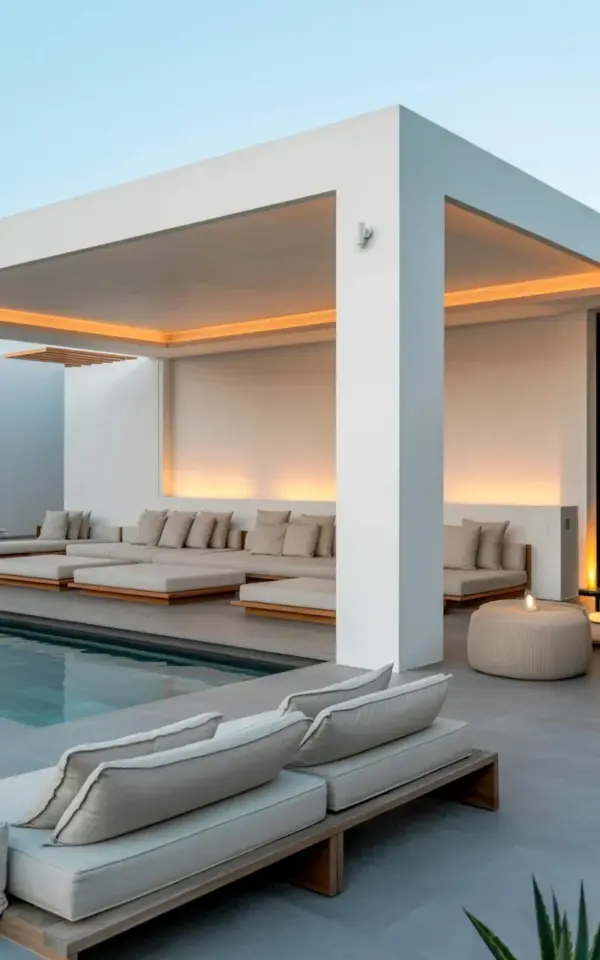
The afternoon sun cuts across the pool deck, throws a long shadow off that white column, and lands on the round beige pouf as if it were posing for a magazine cover. It wasn’t always like this. This modern poolside lounge started as a plain, sun-bleached concrete slab with a cracked hose box and zero ambition. Now it’s a minimalist pavilion with an infinity pool that feels like a private retreat, and the whole thing hinges on a handful of deliberate choices. I’m going to walk you through the before and after, and I’ll include the exact details that made the biggest difference.
Honestly, the hardest part wasn’t picking furniture or deciding on lighting. It was unlearning the idea that a poolside lounge needs to be busy. Tropical plants, tiki torches, a bar cart groaning under glassware. Not here. The goal was stillness. And once I stopped adding, the space started to feel expensive.
From Concrete Slab to Minimalist Pavilion: What Actually Changed
The original slab was functional, but it radiated heat and boredom. It had that uneven gray finish that shows every water stain and leaf. We tore out a small section near the edge to drop in the infinity pool, and the pavilion went up where the old hose box and a sad patio table used to live.
The structure itself is simple: a flat roof, clean geometric lines, and that single white structural column that holds up one corner. The column does real work, but it also becomes the visual anchor. Everything else in the lounge orbits around it. The pool runs along the left side, dark blue water sitting calmly behind the concrete edge, and the deck stays smooth and light gray. That’s it. No fuss.
Why the White Structural Column Works Better Than a Wall
A full wall would have killed the breeze and made the pavilion feel like a cave. The single column keeps the space open, but it gives your eye somewhere to rest when the sun drops. It also creates a natural division between the lounge area and the pool. You almost don’t notice you’re being guided until you try to walk straight through and realize the column quietly nudged you left.
Here’s the thing: white is a cheat code in outdoor spaces. It reflects heat instead of absorbing it, and it pops against the dark water and the amber glow at night. My contractor kept asking if I wanted to wrap it in stone. I said no, and I’m glad I held that line. The column doesn’t compete with anything. It just stands there and looks correct.
Recessed Amber Lighting: How to Get That Warm Night Glow
At dusk, the pavilion changes personality. Recessed lighting runs along the ceiling and throws a warm amber wash across the whole seating area. It’s not dramatic, not spotlights blasting down. It’s more like the ceiling is humming softly. The first night we tested it, a moth the size of my thumb kept dive-bombing the column, and honestly, it looked kind of cinematic.
For your own space, you don’t need a custom millwork setup. Just use recessed LED strips in a warm color temperature, around 2700K, and tuck them into a shallow cove. That gives you the gradient effect instead of harsh pools of light. And please, avoid bright white bulbs. They’ll turn the entire lounge into a waiting room. The amber glow is what makes the beige lounge beds look rich and the concrete deck feel like it’s floating.
Lounge Beds and Pouf Ottomans: Arranging Comfort Without Clutter
The furniture is deliberately uncoordinated. Multiple light beige cushioned lounge beds sit at slightly different angles, like people who wandered in and found their own spot. Between them, that round beige pouf ottoman acts as a casual footrest, a side table when you balance a drink on it, and a seat for the one guest who refuses to commit to a bed.
When you arrange outdoor seating, try this instead of lining everything against the wall:
- Let the beds face the pool, but not all in a straight row. A slight turn, maybe 10 degrees, makes the space feel lived-in.
- Keep the pouf closer to the center of the pavilion, so it breaks up the empty floor and gives people somewhere to drop their sandals.
- Leave a gap between the pavilion column and the first lounge bed, about an arm’s length, so the walkway stays clear.
That last one is a practical thing. I originally had the beds packed too tight and spent all summer doing the sideways shuffle every time someone came through with a drink. Give the space room to breathe.
The Infinity Pool and Light Gray Concrete Deck: Materials That Make Sense
The infinity pool is the loudest quiet feature here. It’s a rectangular shape, nothing fancy, but the dark blue water creates a visual edge that disappears into the horizon. On the deck, the smooth light gray concrete ties everything together without stealing attention. It’s also a practical surface, because it stays cooler than dark pavers and hides the inevitable leaf stains better than white stone.
One thing I learned the hard way: seal the concrete. Twice. The first summer, a spilled citrus drink left a faint pale mark that took forever to fade. After resealing with a matte finish, spills just bead up and wipe away. If you’re installing a new deck, ask for a concrete mix with a light aggregate. It gives the gray a little texture without going full gravel.
Seasonal Styling: Keeping the Pavilion Fresh From Spring to Fall
This is where the trend-aware part kicks in. In summer, the lounge beds stay bare and dry fast. In early spring, I toss on a few woven throws and heavier cotton cushions in a deeper sand tone. When the evenings get cooler, the amber lighting does double duty as a heat source of sorts, at least mentally, and I’ll drag in a portable fire bowl for the month of October.
What doesn’t change is the pavilion’s bones. The white column, the recessed glow, the dark pool water. They carry the design no matter how you layer the textures. Don’t feel pressured to load up on seasonal decorations. A couple of palm baskets, a stack of towels in a muted olive, maybe one ceramic vase with dried grass. That’s all.
Before and After Lessons: What This Project Taught Me
Look, the real lesson is that outdoor spaces don’t need more. They need fewer things, placed with intent. The concrete slab was empty but not minimal. It was just neglected. The pavilion is minimal because every element, the column, the lighting, the furniture, the pool, earns its place.
If you’re planning your own modern poolside lounge, start with the structural bones before you buy a single cushion. Decide where the column or pergola post will go, because that determines the whole layout. Then build the lighting around it. Then bring in the furniture. And if you’re stuck on whether to go with beige or light gray, choose the one that fades into the landscape. Nobody ever squinted at a calm, neutral palette and wished for more neon.
There’s no right time to start, by the way. Some of the best transformations happen in mid-summer when you’ve had enough of staring at a sad patio. If this gave you a clearer picture of what’s possible, go measure your slab and sketch out a column. That first drawing can be ugly. Mine was. It still worked.
Leave a Comment